
The US Department of the Air Force has completed a two-week experiment combining artificial intelligence, human-machine teaming and an agile acquisition approach as it looks to accelerate the development and deployment of new command and control capabilities.
The latest Decision Advantage Sprint for Human-Machine Teaming (DASH) brought together US Air Force and Space Force personnel, researchers and industry software developers to test technologies and working methods for joint command and control.
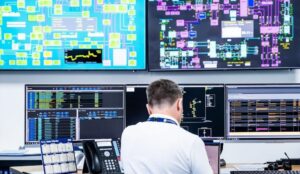
Hosted at the 805th Combat Training Squadron’s Shadow Operations Center-Nellis, the programme was co-led by the Advanced Battle Management System Cross-Functional Team (ABMS CFT) and the Air Force Research Laboratory (AFRL).
An integrated operational crew led by a US Space Force Guardian worked alongside Air Force battle managers and software developers during the exercise.
The experiment was designed to assess how AI could take on data-processing tasks and provide operators with more capacity to interpret information and make decisions.
“Our goal is to get the most advanced capabilities into the hands of the joint force at speed,” said Lt Col Corey Ellsworth, ABMS CFT integration lead.
“This entire framework was built from the ground up to ensure that once a capability is validated here, we can securely and efficiently transition it to the classified networks where our Airmen and Guardians will actually use it in a high-end fight.”
Modular architecture tested
A key element of the experiment was an AFRL-developed “orchestrator”, a government-owned software interface allowing applications from multiple technology providers to be tested within the same modular environment.
The approach is intended to reduce integration barriers and avoid reliance on a single supplier’s proprietary architecture.
“Successfully demonstrating this ‘plug-and-play’ ecosystem was a critical milestone,” said Kevin McFarland, AFRL Advanced Capabilities Directorate project management lead.
“Government ownership of the orchestrator significantly decreases integration bottlenecks. We are no longer locked into a single vendor’s closed architecture.”
Test scenarios were developed by experienced operators at the Shadow Operations Center-Nellis and incorporated operational challenges including geography, logistics and changes to rules of engagement.
The experiment also placed software developers alongside operators, creating a direct feedback process during testing.
Software developed by AFRL’s Information and Spectrum Warfare Directorate provided real-time assessments of baseline trials and trials incorporating vendor technologies.
This allowed developers and operators to review process execution metrics and assess how individual technology solutions affected decision-making.
Agile acquisition model targets faster transition
The DASH programme is also being used to test an acquisition and development model based on closer collaboration between end users, researchers and technology providers.
Rather than developing systems independently before introducing them to operational personnel, the approach allows operators to provide feedback during development and experimentation.
Jeffrey Palumbo, AFRL C3BM Capability Area lead, described the process as “user-producer co-creation”.
“This approach of user-producer co-creation allows for proof of concept, energizes the industrial base, and allows for early operator feedback to shape development,” he said.
“It sets us up to deliver chunks of warfighting capability to the operational force in a rapid and repeatable cycle.”
The Department of the Air Force is seeking to use the process to move technologies from unclassified laboratory testing into classified operational networks more rapidly.
The C3BM Operational Response Team is working with AFRL to identify opportunities to transition capabilities demonstrated during the experiments into the wider Department of the Air Force Battle Network.
Human-machine teaming assessed across services
Researchers from the 711th Human Performance Wing also examined how Air Force and Space Force personnel interacted with the technologies.
AFRL said its observations supported the view that personnel operating across different military domains face similar challenges when processing large quantities of information under time pressure.
Dr Elizabeth Frost, AFRL DASH lead, said the experiment demonstrated that appropriately designed human-machine systems could reduce some of this cognitive workload.
“Both Airmen and Guardians are tasked with synthesizing vast amounts of complex data and prioritizing actions under intense time pressure,” she said.
“This event demonstrated that a well-designed human-machine team can effectively free up an operator’s cognitive resources.”
The ABMS CFT, C3BM acquisition teams and AFRL are now planning further experimentation, with future work expected to examine increasingly complex decision-making scenarios.
The DASH programme will continue to combine operational testing, AI development and rapid acquisition methods as the Department of the Air Force works to shorten the route between technology development and operational deployment.