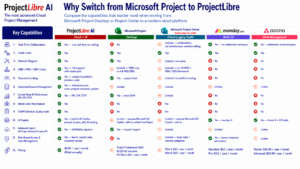

ProjectLibre has launched Cloud AI 2.0, bringing critical path scheduling, portfolio management, enterprise resource planning, project controls, risk analysis and AI capabilities into a single cloud-based project management platform.
The release is aimed at project managers, enterprise teams, PMOs and executives managing complex projects and portfolios, combining professional scheduling functionality with multi-user collaboration and cloud-based delivery.
ProjectLibre said the platform builds on the scheduling technology behind ProjectLibre Desktop, which has reached more than 8.5 million users across 193 countries.
Cloud AI 2.0 extends that environment into a multi-project SaaS platform covering schedules, resources, costs, risks, performance and actual project data.
“Project managers should not have to choose between powerful scheduling and a modern cloud experience,” the ProjectLibre leadership team said.
“Schedules, resources, costs, risk, performance and team actuals remain connected, giving managers and executives a current, reliable view of every project and portfolio.”
AI integrated with critical path scheduling
A central feature of the release is an AI Copilot operating directly on ProjectLibre’s Critical Path Method scheduling engine.
According to the company, users can create complete project schedules from prompts, while the AI can also modify tasks, durations, dependencies and Work Breakdown Structures within the live project model.
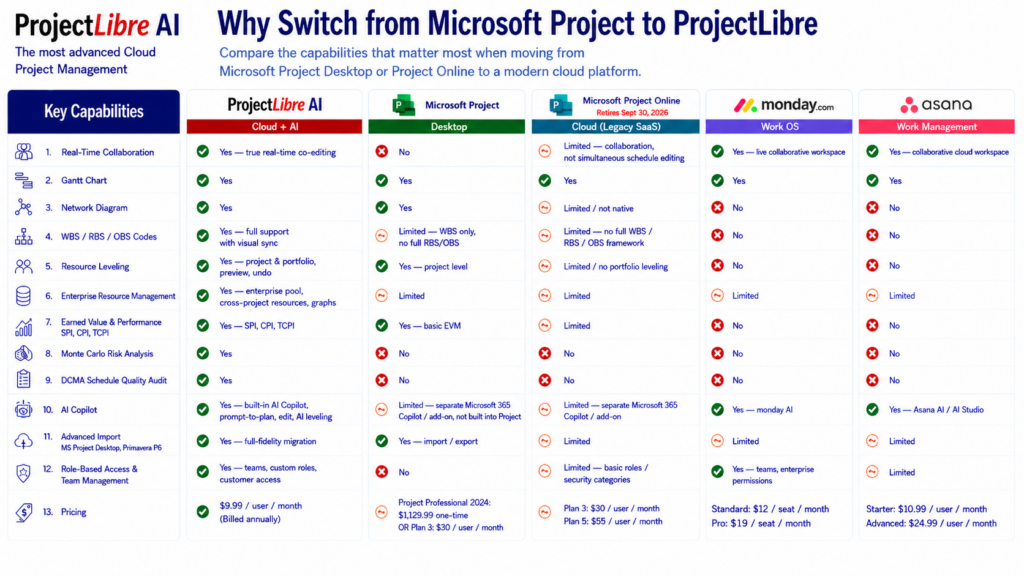
Resource management functionality operates at both project and portfolio level, with connected cross-project resource pools and resource levelling designed to identify over-allocation and assess availability across multiple schedules.
ProjectLibre has also incorporated schedule risk and quality analysis into the platform.
Monte Carlo simulation can be used to calculate completion probabilities and confidence dates, while DCMA 14-point assessments provide schedule-quality auditing.
Earned Value Management functionality includes Schedule Performance Index (SPI), Cost Performance Index (CPI) and To-Complete Performance Index (TCPI) measures.
Professional scheduling capabilities include critical path calculations, free and total float, constraints, project, task and resource calendars, 11 baselines, WBS, RBS and OBS structures, network diagrams and Gantt scheduling.
Project controls connected with execution
Cloud AI 2.0 also connects project planning with progress reporting from delivery teams.
Team members can record actual and remaining work through timecards, with project managers able to establish approval workflows. Once approved, updates are incorporated into the live schedule and reflected in progress, cost and forecast information.
At portfolio level, the platform brings together projects, resources, performance and risk using the same underlying project data rather than requiring separate reporting systems.
ProjectLibre said the approach is intended to provide the accessibility and collaboration of cloud-based work management software while retaining the scheduling logic and project controls required for more complex programmes.
Migration support targets Project Online users
The launch comes ahead of the scheduled retirement of Microsoft Project Online on 30 September 2026.
ProjectLibre is positioning Cloud AI 2.0 as one migration option for organisations affected by the change.
The platform supports imports from Microsoft Project Online, Microsoft Project Desktop, Primavera P6 and ProjectLibre Desktop. ProjectLibre said its migration functionality preserves project information including tasks, scheduling logic, resources, assignments and costs.
ProjectLibre Cloud AI 2.0 is available to existing subscribers and new teams of three or more, priced at $9.99 per user per month when billed annually.