
Trimble has launched a new AI-assisted construction scheduling solution designed to help contractors identify programme risks, coordinate site activities and respond to emerging delays before they affect project milestones.
Unveiled at the Trimble Dimensions User Conference, Trimble Connect Scheduling integrates project schedules with operational data, including weather forecasts, requests for information (RFIs), daily reports and construction planning updates.
The platform uses agentic artificial intelligence to continuously assess project information, identify potential scheduling conflicts and recommend adjustments for project teams to review and approve.
The new capability forms part of the Trimble Connect platform and is available to general contractors and subcontractors across North America.
AI scheduling engine connects project plans with live site data
Construction programmes are frequently affected by changes in labour availability, equipment requirements, material deliveries, weather conditions and design information.
These disruptions can create difficulties when project schedules are maintained separately from operational reporting systems.
Trimble Connect Scheduling aims to address this problem by connecting the master construction programme with information generated by site and office teams.
Its AI planning engine analyses data from multiple sources, including the Trimble Connect common data environment and Trimble Connect Project Management.
The system can also examine historical operational information to identify patterns that may indicate emerging schedule risks.
According to Trimble, the technology is designed to detect potential delays before they become visible in conventional programme reporting.
Nathan Patton, Product Management Leader for AI and Office-to-Field Solutions at Trimble, said the platform was developed to move contractors towards earlier identification of scheduling problems.
“Trimble Connect Scheduling shifts contractors away from static charts to proactive intelligence that catches micro-delays before they snowball into project-wide overruns,” he said.
Platform supports schedule risk assessment and activity resequencing
The new solution introduces several capabilities intended to improve construction planning and programme controls.
Its continuous risk assessment function reviews project information, including RFIs, weather data and Building Collaboration Format (BCF) topics, to identify potential impacts on planned activities.
Where risks are detected, the AI engine can recommend schedule adjustments, including changes to activity sequencing and the use of available programme float.
These recommendations remain subject to review and approval by project teams.
The platform also connects short-term site planning activities with the overall construction programme.
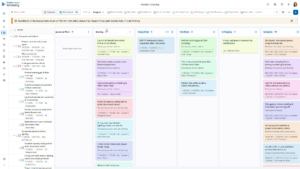
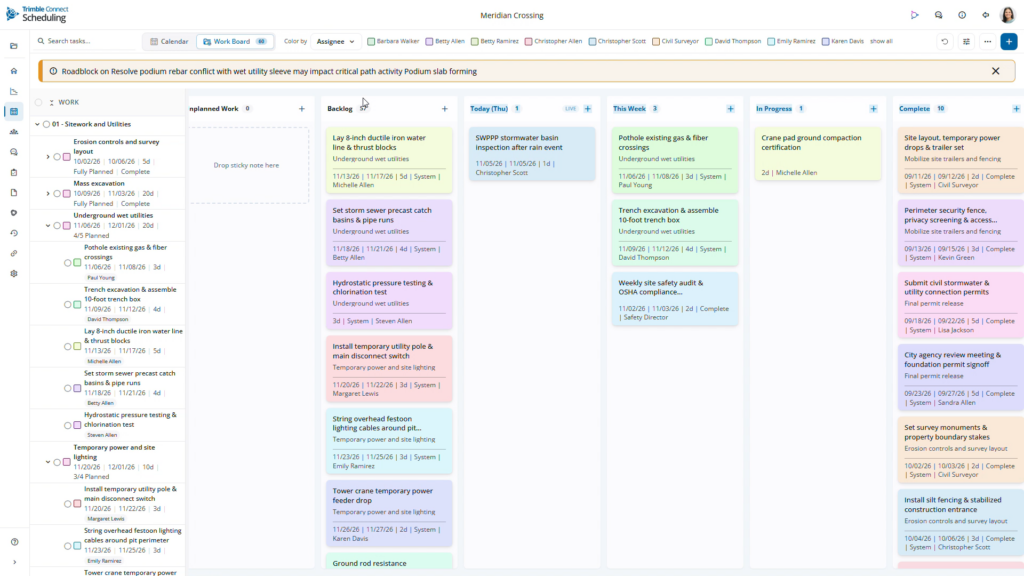
Colour-coded look-ahead tasks are linked directly to the master Gantt chart, allowing field teams and project managers to maintain a shared view of upcoming work.
This integration is intended to reduce discrepancies between site-level plans and the schedules used for project reporting and management.
For project controls professionals, the approach brings together short-term construction planning and longer-term programme monitoring within a single environment.
Integration with Primavera P6 and Microsoft Project
Trimble Connect Scheduling supports the import of schedules from established project planning applications, including Oracle Primavera P6 and Microsoft Project.
According to Trimble, imported schedules can retain their existing logic and baselines, allowing contractors to incorporate the new platform into established planning processes.
Users can also develop and revise schedules directly within Trimble Connect Scheduling.
The system is designed for collaboration between site supervisors, project managers, planning engineers, estimators and senior management.
By allowing different teams to update and review project information, Trimble aims to reduce reliance on disconnected spreadsheets, emails and other informal scheduling processes.
The platform uses a construction-specific AI model trained on Trimble project data, which the company says provides greater contextual understanding of construction activities and scheduling requirements.
Contractors participate in development and testing
Trimble developed the scheduling solution in collaboration with construction contractors, with several organisations using the platform during its development.
DILFO Mechanical was among the companies involved.
Brendan Myers, Vice President of DILFO Mechanical, said the software had supported both operational planning and coordination with general contractors.
“It’s user friendly and easy enough for our field teams to pick up quickly, yet flexible enough to adapt to different jobs,” he said.
Consolidated Construction also participated in the development process.
Shelly Klarner, Software Specialist at Consolidated Construction, said the platform allowed teams to manage activities ranging from major project milestones to detailed construction tasks.
The contractor feedback suggests the system has been designed to accommodate different levels of scheduling complexity, although Trimble has not disclosed independently verified reductions in project delays or quantified productivity improvements.
AI expands role in construction project controls
The launch reflects growing interest in using artificial intelligence to support construction scheduling and project controls.
Traditional critical path method scheduling remains central to construction programme management, but the effectiveness of project schedules depends on the quality and timeliness of information used to update them.
Trimble’s approach introduces automated analysis of operational data to identify risks and recommend corrective actions while retaining human oversight of scheduling decisions.
The integration of master schedules, field look-ahead plans and live project information could provide contractors with earlier visibility of potential disruption.
However, the effectiveness of the system will depend on the accuracy of project data, the integration of existing planning processes and how consistently site teams maintain operational records.
Trimble Connect Scheduling is now available in North America for general contractors and subcontractors working across construction sectors.
The company has not announced a timetable for availability in other regions.