
Abu Dhabi Fund for Development (ADFD) and the World Bank Group have signed a cooperation agreement aimed at developing a pipeline of sustainable infrastructure and development projects across emerging economies, with a focus on project preparation, financing and technical collaboration.
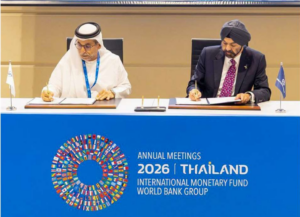
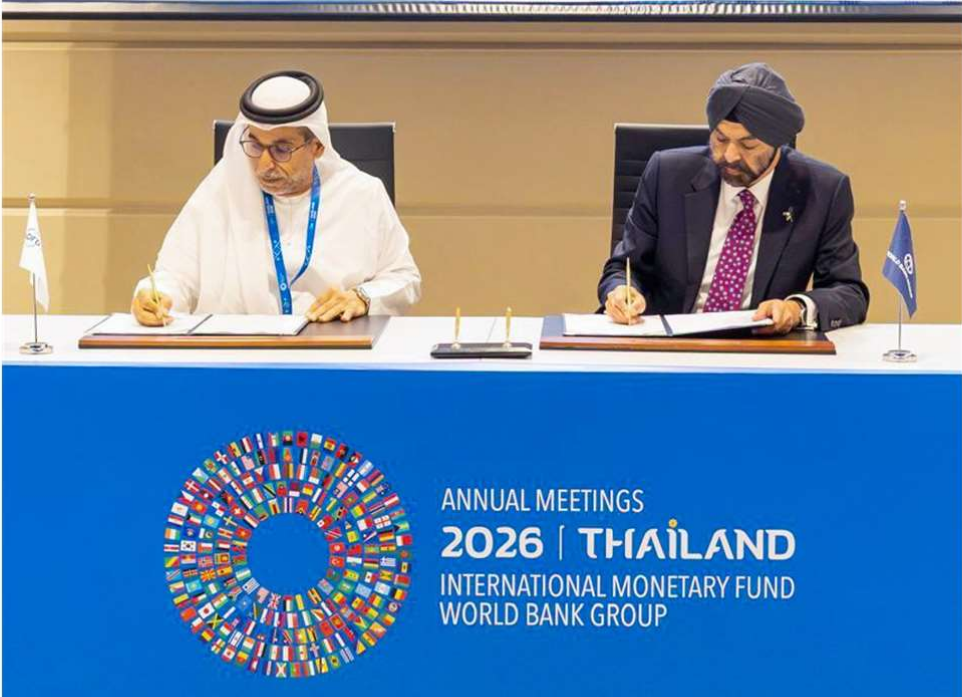
The Memorandum of Understanding (MoU), signed during the 2026 Annual Meetings of the International Monetary Fund and World Bank Group, establishes a framework for the two institutions to explore joint development initiatives.
The agreement was signed by Mohamed Saif Al Suwaidi, Director General of ADFD, and Ajay Banga, President of the World Bank Group.
The partnership will combine ADFD’s development financing capabilities and government relationships with the World Bank Group’s technical expertise, country-level knowledge and financing instruments.
Its objective is to support long-term economic development, strengthen resilience and improve access to essential services in developing countries.
Cooperation to target energy, water and digital infrastructure
Under the agreement, the two institutions will explore opportunities for collaboration across several priority sectors.
These include energy, water security, agriculture, food security, digital infrastructure and the responsible deployment of artificial intelligence.
The cooperation framework covers knowledge exchange, institutional capacity building, project preparation and potential co-financing arrangements.
A central objective is to identify and develop financially viable projects that can attract investment and deliver measurable economic, social and environmental outcomes.
The institutions will also explore ways to align development financing with national priorities and improve the preparation of projects before they move towards implementation.
The agreement does not specify an initial financing commitment, individual project allocations or delivery schedules.
Project preparation and financing central to partnership
The collaboration places particular emphasis on strengthening the early stages of project development.
By combining financing capabilities with technical assistance and country-level expertise, ADFD and the World Bank Group aim to support the identification, assessment and preparation of bankable projects.
The approach is intended to address challenges that can prevent infrastructure and development initiatives from progressing from initial proposals to funded implementation.
Potential co-financing arrangements could also enable the institutions to combine resources for projects requiring substantial capital investment.
Mohamed Saif Al Suwaidi said the partnership reflected the need to connect development funding with practical implementation and measurable outcomes.
“Development finance must go beyond funding individual projects to create lasting, measurable change in the economies and communities they serve,” he said.
“By partnering with the World Bank Group, we aim to align financing with global expertise and country-level priorities to develop solutions that address critical development needs, strengthen resilience and create opportunities for sustainable growth.”
He added that the cooperation would seek to translate development priorities into bankable projects capable of delivering long-term benefits to communities.
Water security remains a development priority
The agreement forms part of ADFD’s wider engagement with international development institutions during the 2026 Annual Meetings.
Water security is among the areas receiving particular attention, ahead of the United Nations Water Conference scheduled to take place in Abu Dhabi in December 2026.
ADFD is using its international partnerships to highlight the need for greater investment in sustainable water infrastructure and improved resilience in vulnerable communities.
The new agreement provides a framework for potential cooperation on water-related projects alongside investments in energy, agriculture and digital infrastructure.
It also creates opportunities for the two institutions to share technical knowledge and strengthen the capacity of organisations responsible for developing and implementing projects.
The MoU establishes a basis for future collaboration rather than committing the institutions to a defined programme of investments.
Specific projects, financing arrangements and implementation plans will depend on subsequent discussions and agreements between ADFD, the World Bank Group and participating countries.