
Otis has been selected as the sole provider of vertical transportation systems for Tianjin 117 Tower, supplying, modernising and refurbishing a total of 251 elevators and escalators for one of China’s most ambitious supertall construction projects.
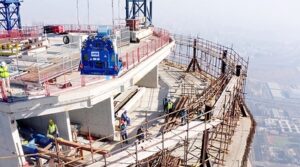
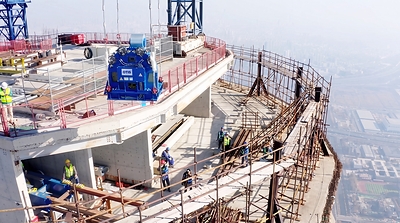
The nearly 600-metre tower is currently the tallest building under construction in China. At 596.6 metres, it is expected to become the tallest building in northern China and the country’s third tallest when completed.
The development will also contain China’s highest occupied floor, at 584.1 metres.
Otis was originally selected to provide elevators and escalators during the first phase of construction in 2013. Its latest appointment expands that involvement, with the company now responsible for an integrated vertical transportation solution encompassing existing and new equipment.
The programme will include modernisation and refurbishment of elevators and escalators already installed, the installation of additional systems and ongoing service support.
Sally Loh, President of Otis Greater China, said: “Tianjin 117 Tower is an extraordinary project that reflects the future of high-rise mobility in China.
“By combining our pioneering Otis SkyRise technology, digital service capabilities and local manufacturing expertise, Otis is proud to support this landmark and help shape how people move through, experience and interact with one of China’s most ambitious developments.”
Four high-rise elevator records targeted
Named after its 117 above-ground floors, the Tianjin development will incorporate some of Otis’ most advanced high-rise elevator technology.
The company said the project is expected to establish four records for its vertical transportation systems.
A total of 53 SkyRise double-deck and super double-deck elevators will be installed, representing the largest number of Otis double-deck elevators within a single building.
Two SkyRise elevators will operate in hoistways extending more than 597 metres, which Otis said will make them the longest elevator hoistways within a building globally.
Three super double-deck elevators will travel at speeds of up to 10 metres per second and reach heights of up to 463 metres, making them the company’s fastest and highest-rise elevators of this configuration.
Another two double-deck elevators will reach speeds of 12 metres per second, the fastest within Otis’ current portfolio.
Double-deck elevators use two vertically stacked cabs to serve adjacent floors through the same hoistway. The configuration can reduce the amount of building space required for elevator cores compared with equivalent single-deck systems.
Super double-deck technology additionally allows the distance between the two cabs to be adjusted during operation, enabling the elevators to accommodate variations in floor-to-floor heights.
Digital systems to support tower operations
The vertical transportation package will combine high-speed elevator technology with digital monitoring and energy management systems.
SkyRise elevators will incorporate aerodynamic cab designs developed using computational fluid dynamics simulation and wind-tunnel testing to reduce wind noise and manage pressure changes during high-speed journeys.
Otis ReGen drive technology will recover electrical energy generated during braking and feed it back into the building’s power network, allowing that electricity to be used elsewhere within the development.
The company will also deploy its Panorama 3 elevator management system and Otis ONE connected service technology.
These systems provide real-time monitoring, traffic forecasting, intelligent dispatching and operational data intended to support predictive maintenance and improve the reliability of the tower’s vertical transportation infrastructure.
The wider package includes digitally connected Gen3 elevators alongside Link and Public escalators.
Complex installation programme
Delivering 251 elevators and escalators across a building approaching 600 metres presents a substantial engineering and project management challenge.
Otis has established a dedicated project team covering design, installation, commissioning, inspection and project management, while coordinating its activities with the customer and other organisations involved in construction.
The company said more than 100 field professionals remained on site during the Spring Festival period as it worked to maintain the project schedule.
The installation programme must also integrate newly supplied equipment with elevators and escalators dating from the tower’s earlier construction phase, requiring refurbishment and modernisation alongside new works.
Once completed, Tianjin 117 Tower will add another major supertall development to China’s skyline, with its extensive vertical transportation infrastructure playing a critical role in moving occupants efficiently across its 117 floors.