
Infrastructure lifecycle management software provider Sitenna has launched a new AI connector that allows project teams to access programme data, identify delivery risks and analyse infrastructure performance directly through enterprise AI platforms including ChatGPT, Claude, Gemini and Microsoft Copilot.
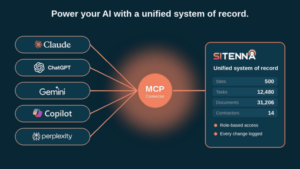
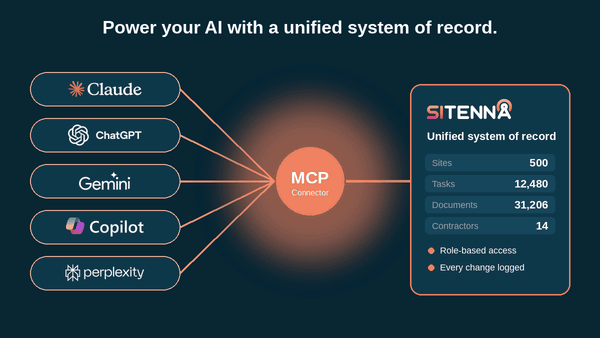
The Sitenna MCP Connector connects these AI tools to the company’s infrastructure management platform, enabling users to query project information through natural-language instructions rather than navigating multiple dashboards, filters and reports.
The technology is designed for organisations managing complex infrastructure portfolios, including electricity networks, telecommunications infrastructure and pipelines.
According to Sitenna, the connector can help teams identify projects experiencing delays, investigate potential causes and assess performance across individual assets or entire infrastructure programmes.
The connector is available to Sitenna Enterprise customers at no additional cost.
AI integration targets fragmented infrastructure project data
Infrastructure programmes frequently involve large volumes of information distributed across project management systems, spreadsheets, contractor reports and operational databases.
This can make it difficult for project managers and programme directors to establish an accurate picture of delivery performance, particularly when managing multiple sites or geographically dispersed assets.
Sitenna’s new connector is intended to address this challenge by allowing AI applications to access information held within a centralised system of record.
The technology uses Model Context Protocol (MCP), an open standard that enables AI applications to connect with external data sources and software tools.
Through the connector, authorised users can ask questions about project schedules, asset performance and programme progress using their preferred AI platform.
The system retrieves information from the sites, projects and assets that the individual user is permitted to access.
Sitenna says this approach can provide faster access to project information while reducing reliance on manually prepared reports.
Daniel Campion, CEO and Co-Founder of Sitenna, said infrastructure organisations were increasingly using AI but often lacked reliable connections to their operational data.
“The risk is that it ends up working on whatever spreadsheet it can find, in a chat nobody else can see,” he said.
“With the MCP Connector, our Enterprise customers bring the AI they have already chosen to one verified, auditable program record.”
Natural-language queries support programme risk identification
The connector allows project teams to generate tailored reports and analysis based on their specific information requirements.
Rather than relying exclusively on predefined dashboards, users can ask AI tools to examine particular projects, compare performance across sites or identify activities that may require intervention.
For example, a programme manager could request an overview of projects falling behind schedule and investigate the information associated with those delays.
The system is also designed to support workflow development and improvement.
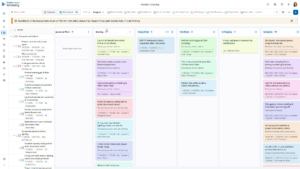
Administrators can describe a required process using natural language, allowing AI to propose a workflow for review.
Once approved, the workflow can be implemented within Sitenna and made available to relevant project teams.
AI can subsequently monitor workflow performance against planned activities and recommend adjustments, although administrators must approve changes before they are implemented.
These capabilities are intended to support more consistent project execution and reduce administrative work associated with programme monitoring.
Security and access controls remain central to deployment
Sitenna has emphasised information security and accountability as part of the connector’s design.
The company says AI applications operate within each user’s existing Sitenna permissions, preventing them from accessing or modifying information beyond their authorised scope.
Every action is recorded against the relevant user account, providing an audit trail of activity.
Authentication is managed through OAuth, while data is encrypted during transmission and remains within the customer’s designated region.
According to Sitenna, the connector is also covered by the company’s SOC 2 audit and penetration testing arrangements.
Administrators can revoke user access when required.
These controls are particularly relevant to infrastructure owners managing commercially sensitive information, regulated assets and programmes involving multiple contractors.
The connector is intended to allow different organisations working on the same programme to access a shared project record while maintaining separate permissions and using their preferred AI applications.
Open-standard approach supports multiple AI platforms
Unlike systems that require organisations to use a single embedded AI assistant, Sitenna’s connector is designed to work with several established enterprise AI platforms.
Supported applications include Claude, ChatGPT, Gemini and Microsoft Copilot.
This allows infrastructure owners, delivery partners and systems integrators to use different AI tools while accessing information from the same underlying project management environment.
Sitenna says the open-standard architecture also allows customers to benefit from improvements to their chosen AI platforms without waiting for equivalent functionality to be developed within Sitenna itself.
The approach could support organisations operating across complex supply chains, where different project participants have established technology preferences and internal governance requirements.
Implications for infrastructure project delivery
The launch reflects growing interest in using AI to improve access to project information and support earlier identification of delivery risks.
For infrastructure project professionals, the potential applications include programme reporting, schedule monitoring, workflow management and coordination between project stakeholders.
Connecting AI tools to an established project information system may also reduce the risk of decisions being based on outdated or inconsistent records.
However, the reliability of AI-generated analysis will continue to depend on the quality, completeness and accuracy of the underlying project data.
Sitenna has not disclosed independently verified productivity improvements, quantified cost savings or reductions in project delays resulting from the connector.
The launch nevertheless represents a further development in AI-enabled project controls, with an emphasis on allowing project teams to interrogate existing programme data through familiar enterprise applications.
By combining natural-language access with permission controls and auditable workflows, Sitenna is seeking to make AI-assisted analysis a more integrated part of infrastructure project management.