
The International Atomic Energy Agency (IAEA) has launched a new international research initiative to explore how artificial intelligence and isotope hydrology can be combined to improve water resources management, as countries face mounting pressures from climate change, drought, pollution and growing demand.
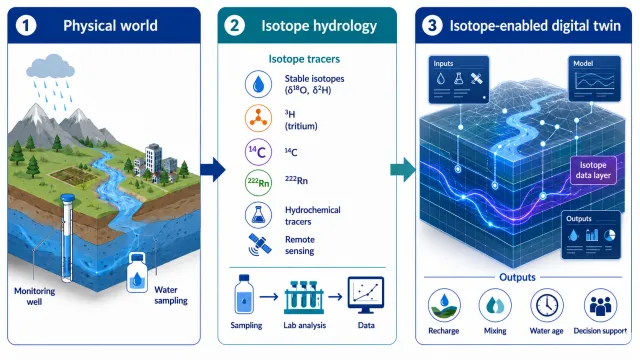
The new Coordinated Research Project (CRP) will develop practical guidance on the responsible use of AI in isotope hydrology while investigating how isotope data can be integrated into digital twins to support evidence-based water management.
The initiative aims to help countries make better decisions about groundwater resources by combining AI with scientific methods that reveal where water originates, how it moves through the environment, how old it is and how vulnerable it is to contamination or overuse.
Combining AI with scientific evidence
Water managers are increasingly turning to AI to analyse large and complex datasets, particularly where monitoring information is incomplete. However, the IAEA warns that AI alone cannot provide reliable answers without robust scientific foundations.
The new research project seeks to establish an internationally recognised framework to ensure AI applications remain transparent, scientifically valid and suitable for real-world water management decisions.
Robert Kalin, from the University of Strathclyde, said AI should support rather than replace scientific expertise.
“The goal is not to replace expert judgement, but to strengthen it. AI can help manage complex information, but isotope hydrology and conceptual models are needed to test whether the interpretation makes sense.”
The project will also define minimum standards for data quality, metadata and quality assurance, helping ensure isotope datasets collected by different countries and laboratories can be used consistently within AI models.
Yuliya Vystavna, isotope hydrologist at the IAEA, said many countries need better ways to maximise the value of existing data.
“For countries with limited monitoring capacity, the priority is not only more data, but better use of existing data. A clear framework can help ensure that digital tools support practical decisions without hiding uncertainty.”
Strengthening digital twins
A major focus of the programme is the integration of isotope hydrology into digital twins.
Digital twins are virtual models that combine real-world monitoring data, computer simulations and predictive analytics to improve understanding of complex systems and test future scenarios.
Although digital twins are already being used for flood forecasting and urban water management, most currently lack isotope information, which provides independent evidence about groundwater movement, recharge, water age and mixing processes.
According to the IAEA, incorporating isotope hydrology could significantly improve the reliability of these models by validating whether simulated water flows accurately reflect real hydrological conditions.
The research programme will investigate how AI-supported workflows can combine isotope evidence with digital twin technologies for applications including groundwater vulnerability, aquifer recharge, pollution management, salinisation and climate-related water stress.
Research organisations interested in participating have until 31 August 2026 to submit proposals.
Project management perspective
The initiative highlights the increasingly important role of project management in multidisciplinary scientific research, where success depends on coordinating expertise across hydrology, nuclear science, artificial intelligence, environmental modelling and digital technologies.
Developing internationally accepted AI frameworks requires more than technical research. It demands structured governance, standardised methodologies and collaboration between research institutions operating under different regulatory environments and scientific practices. Coordinating these workstreams while maintaining consistent data quality and scientific integrity represents a significant programme management challenge.
The project also reflects a wider trend towards integrating AI into critical infrastructure decision-making. Rather than treating AI as a standalone solution, the IAEA is emphasising governance, validation and evidence-based implementation, principles that mirror best practice in project management. Establishing clear quality standards, transparent decision frameworks and robust assurance processes will be essential if AI is to earn the confidence of governments responsible for long-term water security.
As digital twins become increasingly common across infrastructure, utilities and environmental management, initiatives such as this demonstrate how project professionals will play an important role in delivering complex programmes that combine emerging technologies with scientific expertise and public policy objectives.