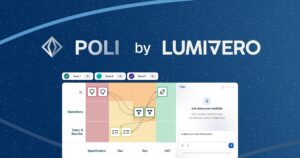

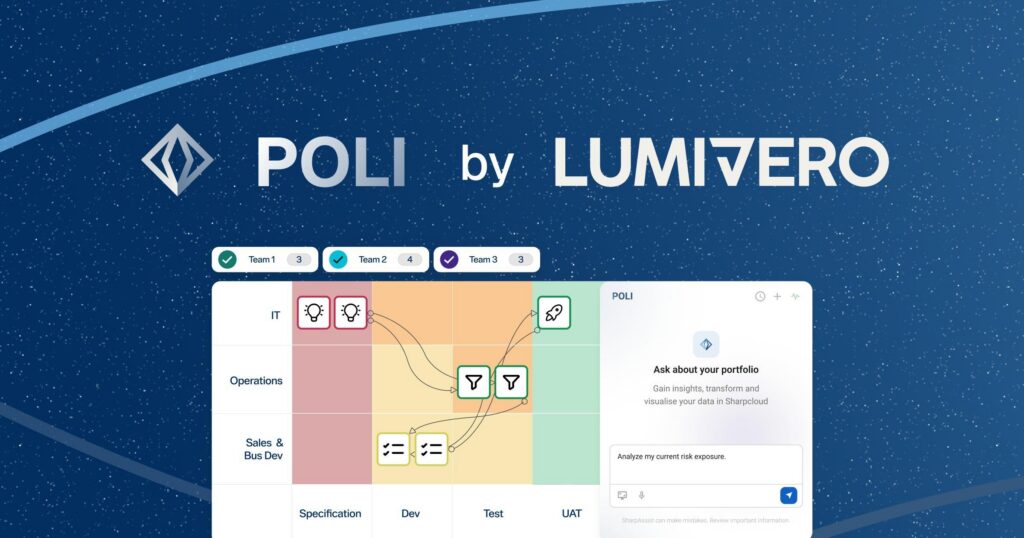
Lumivero has launched POLI, a family of AI agents designed to help project portfolio managers identify delivery risks, evaluate investment decisions and assess the impact of changes across complex project portfolios.
Integrated into Lumivero’s SharpCloud platform, the technology enables project professionals to interrogate existing portfolio data, conduct scenario analysis and examine dependencies between projects, risks and strategic commitments using natural-language instructions.
The launch targets organisations managing complex capital investment portfolios, including those operating across defence, energy, manufacturing and government.
Fragmented data remains a barrier to effective portfolio management
Research published by Lumivero in its The State of AI in Capital Project Decision-Making report found that 81% of respondents identified fragmented data as a leading challenge.
Organisations managing interconnected project portfolios frequently rely on information distributed across spreadsheets, project management systems and risk registers, making it difficult to assess the wider implications of individual project decisions.
SharpCloud brings information from existing systems into a connected portfolio model that recalculates as underlying data changes.
POLI enables users to interrogate this information without requiring specialist knowledge of the platform or waiting for scheduled reporting cycles.
Gareth Morrison, Chief Executive Officer of Lumivero, said access to actionable information remained a challenge for organisations managing complex portfolios.
“Organizations running complex project portfolios aren’t short on data. They’re short on answers,” he said.
“POLI closes the gap between the data and the decision.”
AI-powered scenario analysis supports portfolio-level decisions
The new agents are designed to help project professionals understand how changes to individual projects could affect wider portfolio performance before committing resources or approving decisions.
According to Lumivero, POLI enables teams to:
- Identify projects at risk of missing delivery commitments.
- Convert existing spreadsheets into working portfolio models.
- Create calculations and reporting views using natural-language instructions.
- Simulate changes and assess their impact on delivery dates and anticipated benefits.
- Examine dependencies between projects, risks and strategic commitments.
The scenario modelling capability is particularly relevant to organisations managing portfolios where changes to schedules, budgets or supplier arrangements can affect multiple interconnected projects.
By examining these dependencies before implementing changes, portfolio managers can assess potential consequences beyond the immediate project.
Human oversight remains central to AI governance
Lumivero’s research also identified concerns surrounding trust, accountability and information security.
Only 10% of respondents said they would act on an AI recommendation without significant review, while 56% identified data privacy and security as a leading purchasing concern.
In response to these requirements, POLI has been designed to show how its answers are produced, with changes to portfolio models requiring human approval before implementation.
Approved changes can also be reversed.
Lumivero says the agents operate within existing user permissions and that SharpCloud does not use customer data to train AI models.
Organisations can deploy POLI using their own large language models or those provided by Lumivero. Agents can also be configured to reflect individual organisations’ project structures, risk management frameworks and terminology.
AI moves into strategic portfolio management
While many applications of AI in project management have concentrated on individual activities such as scheduling, reporting and administrative automation, POLI is designed to operate at portfolio level.
Its focus is on connecting project delivery information with strategic objectives, investment priorities and anticipated business benefits.
This has particular relevance for portfolio directors, project management offices (PMOs) and investment committees responsible for balancing competing demands for capital and resources.
The ability to model the wider consequences of proposed changes could support project prioritisation, investment appraisal, risk management and strategic roadmapping.
However, the reliability of these assessments will depend on the accuracy of underlying project data and the completeness of mapped dependencies.
Lumivero has not disclosed independently verified improvements in portfolio performance, reductions in cost overruns or quantified savings resulting from the introduction of POLI.