

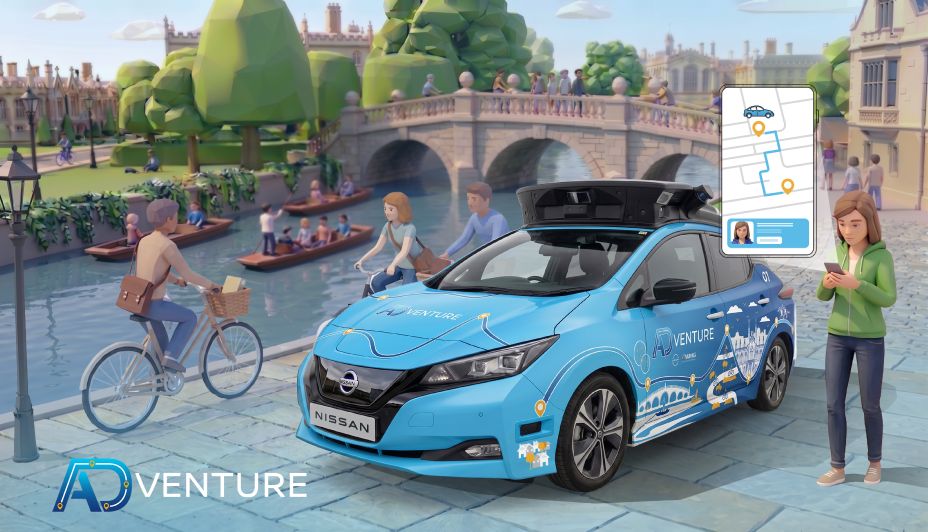
Nissan is leading a £3 million autonomous mobility project in Cambridge that will test how self-driving vehicles could operate as part of a real-world transport service, with a public-road demonstration planned at the end of the programme.
The ADventure project will move beyond testing autonomous driving technology alone to examine how services could be designed around the needs of communities, passengers and existing transport networks.
Engineers at Nissan Technical Centre Europe will lead the collaborative programme, working with WMG and Partners for Automated Vehicle Education UK (PAVE UK), alongside local authorities, commuters and residents.
Cambridge has been selected for the project’s first real-world trial, with the programme intended to develop an approach that could subsequently be replicated elsewhere in the UK.
The £3 million consortium project is backed by the UK Government’s CAM Pathfinder programme and forms part of efforts to accelerate the development and deployment of connected and autonomous mobility technologies.
Project to test autonomous services in real-world conditions
ADventure will focus on three areas: designing autonomous mobility services around communities, understanding how to build passenger confidence and testing autonomous driving technology under real-world conditions.
Researchers will examine how autonomous vehicles could complement existing transport services and improve accessibility for people who cannot drive. Potential use cases include transporting passengers to medical appointments.
Local communities will be involved in the programme to help researchers understand passenger requirements and how autonomous services could improve access to transport and other opportunities.
David Moss, Senior Vice President, Research and Development at Nissan Africa, Middle East, India, Europe and Oceania, said: “This project is an important step for autonomous mobility in the UK.
“With UK Government backing, it will take autonomous vehicle research beyond central London and into another city, helping us understand how these services can work for different communities and real-life journeys.”
Existing Nissan LEAF test vehicle to be deployed
The programme will use an existing 2022 Nissan LEAF-based test vehicle equipped with autonomous driving technology developed by Nissan.
The vehicle has previously been used in UK research projects and will now support evaluation of passenger mobility requirements and collection of real-world data in Cambridge.
WMG will contribute expertise in autonomous vehicle safety and user experience.
Professor Siddartha Khastgir, Head of Safe Autonomy at WMG, said the project would involve working with members of the public to develop a mobility service that addresses both user requirements and wider transport priorities.
“Applying our deep safety and user-experience expertise to the ADventure project, we will be able to co-create a safe mobility service design with the public in a way that meets both their needs and the city’s transport priorities,” he said.
Cambridge was selected following a scoping process that considered its existing transport innovation and autonomous mobility research activity. The city has previously hosted autonomous driving initiatives and will provide an environment for examining how the technology could interact with established transport networks.
Cllr Brian Milnes, Chair of the Greater Cambridge Partnership, said the organisation would work with the project partners to explore the potential community and transport benefits of self-driving vehicles.
Programme builds on previous autonomous driving projects
ADventure builds on Nissan’s previous UK autonomous driving research programmes, including HumanDrive, ServCity and evolvAD.
Those projects have contributed to the company’s research into how autonomous driving systems perform across different road and traffic environments.
The latest programme broadens the focus from vehicle performance towards the operation of an autonomous mobility service, including passenger experience, community requirements and integration with local transport.
Nissan said the work could ultimately provide a model for autonomous mobility services capable of being applied in other UK locations.
The project will conclude with a public-road demonstration in Cambridge, bringing together the technology, safety, user experience and service-design work developed during the programme.